Berkeley Analytics Lab Showcase
2026 Lab Showcase

From posters to demos and interactive features, the Berkeley Analytics Lab Showcase is a culmination of hands-on analysis and research conducted by Berkeley Analytics students, who utilize cutting-edge analytical methods and quantitative tools to tackle real-world business and industry challenges.
This showcase highlights the transformative power of analytics across industries—from sports and entertainment to fashion, finance, generative AI, healthcare, and beyond.
Event agenda
- 8:00 AM – 9:00 AM
Judges Welcome Check-in & Coffee
- 9:00 AM – 10:30 AM
Lab Showcase Judging – Blum Hall
- 10:30 AM – 11:00 AM
Judging Calculations – Blum Hall
- 11:00 AM – 1:00 PM
Reception & Speakers – Sudjarta Hall- Master of Analytics Student Speaker
- Program Director, Professor Alper Atamtürk
- Analytics Lab Professor Daniel Pirutinsky
- Director of Career Services, Dr. Diana Chavez
Guest Judges

Patrick Conner
Data Scientist
Nomis Solutions

Gerson Morales Dera
Commercial Real Estate Analyst
Newmark

Rohit Pugazhen
SDE
Amazon

Konstantin Zhivotov
Full-Stack AI Engineer
Alterion

Sri Lahari Dwadasi
Data Engineer
Bright Machines

Monika Voutov
Founder, CEO
TSS Rhea

Naga Vyjayanthi
Research
Stanford

Veer Arora
Data Science
Kaiser Permanente

Priyanka Ravichandran
Software Engineer II
Upscale AI

Carrie Beam
Academic Director, MSBA Program
UC Davis

Alireza Boloorchi
CEO
Catch Up AI

Shruthi Racha
Engineer
DevRev
2026 Student Projects
Team: Madhumitha Chandrasekaran, Dahai Huang, Yuqiao Jiang, Vineet Reddy, Allen Yuan
Description: Cloud systems often run more machines than necessary due to inefficient workload scheduling and over-allocation of resources. In this project, we build a system that anticipates how workloads will behave and uses those insights to improve scheduling decisions. By simulating alternative strategies, we show how smarter allocation can reduce idle capacity across large clusters. Even small efficiency gains compound into meaningful reductions in energy consumption and emissions. Our work connects predictive analytics to real operational impact, turning data into actionable decisions. Ultimately, the goal is simple: fewer machines running, for the same level of service.
Team: Kai Chang, Tonya Yermilova, Chenyang Qian, Jiatong Wu, Qiang Zeng, Xuexuan Wang
Description: The project investigates the intersection of public service delivery and urban economic shifts using a comprehensive dataset of San Francisco 311 calls. By leveraging Python for data engineering and visualization, the study maps out service request patterns and identifies significant disparities in response times across different zip codes. A core component of the research involves integrating external real estate datasets to see how service quality aligns with fluctuating rent prices. This correlation helps determine if municipal attention shifts in response to gentrification or if certain neighborhoods face systemic disinvestment. Ultimately, the project aims to develop predictive insights into neighborhood trends and equity issues within the city’s infrastructure. Through this data-driven approach, the analysis highlights how non-emergency service requests can serve as a powerful proxy for understanding broader socioeconomic inequality.
Team: Aaryan Magnani, Yuan Liang, Joshua Chen, Fangfei Li, Fan Gao, Lucas Xu
Description: The Airbnb Intelligence Platform is a comprehensive, multi-city decision-support tool designed to empower both current hosts and prospective investors through machine learning-driven insights. Utilizing CatBoost models and NLP-enriched sentiment analysis, the application provides real-time market visualization, Superhost probability forecasting, and predictive pricing for new listings across San Francisco, NYC, and Chicago. A standout feature is the integration of SHAP-based explanations, which translate complex model outputs into transparent, actionable recommendations for optimizing property performance and amenity selection. The platform’s scalable architecture is built for growth, allowing for the seamless integration of new cities without requiring code modifications. By bridging the gap between raw short-term rental data and strategic execution, this tool helps users maximize ROI and achieve operational excellence in a competitive landscape.
Team: Suehyun Baig, Peggy Ding, Yuwei Dong, Constantin Ertel, Lili Jiang, Andrew Lai, Yifei Liu
Description: The Food Nutrition Advisor is an AI-powered tool that analyzes food images to extract macronutrient data and cross-references it with users’ personal health profiles to deliver personalized dietary guidance. The system continuously adapts personalized dietary recommendations based on users’ daily uploaded meal images, while incorporating built-in safety guardrails to prevent high-risk or harmful behaviors. While the current version of the system is limited to extracting macronutrient information from food images, future iterations aim to expand nutrient coverage to include micronutrients and introduce customized recommendation styles tailored to individual user preferences and goals. It is designed to complement, not replace, professional dietary guidance, empowering users to make informed, proactive health decisions.
Team: Arthur Fang, Yuyao Xia, Yuyang Sun, Jiayuan Wang, Yalu Kong, Kevin Zheng, Avya Kalra
Description: NYC Citi Bike often faces rebalancing problems, with some stations running out of bikes while others become overcrowded, which makes the system less reliable for riders and harder to manage efficiently. Our project aims to help operations teams anticipate these imbalances earlier by predicting station-level bike shortages and surpluses using historical trip patterns, time variables, weather conditions, MTA subway ridership, and nearby neighborhood features. We built a machine learning pipeline centered on an MLP model to estimate rebalancing gaps and translate the results into practical operational signals. To make the output easy to use, we created an interactive dashboard with a map that highlights stations by predicted demand pressure, along with filters for time, weather, and borough. The dashboard also provides a ranked list of stations so dispatchers can quickly see where intervention is most urgent. Overall, the project connects predictive modeling with a simple decision tool that can support more proactive and data-driven bike rebalancing.
Team: Lisa Li, Qicheng Sun, Xutong Dong, Yuan Jiang, Zhaoning Liang, Zizhou Fang
Description: This project develops a driver-facing fatigue intervention tool that combines video-based drowsiness detection with simple driver-provided context, such as driving duration and time since the last break. A convolutional neural network analyzes sampled video frames and produces a drowsiness probability sequence over time. The sequence is then integrated with contextual inputs to generate a unified fatigue score. Based on this score, the system provides an interpretable recommendation, such as whether the driver should remain alert, take a break soon, or stop for an immediate break. The tool is presented through an app-style interface that guides the user from session setup to analysis results and alert feedback. This project demonstrates how machine learning can be integrated into an accessible human-centered interface for fatigue monitoring and intervention.
Team: Gavin Zeng, Henry Zhang, Jasmine Chen, Munazza Nadir, Nick Fitzpatrick, Rimsha ljaz
Description:When an emergency happens, response time can mean the difference between life and death, but most response centers are placed without data-driven guidance. We analyzed millions of historical accident records across California to determine the optimal locations for Emergency Response Centers, minimizing response time and prioritizing high-severity incidents. We also built a predictive model that forecasts where accidents are most likely to occur by location, time, and day of week. Everything comes together in an interactive dashboard that helps planners, dispatchers, and policymakers make smarter, faster decisions about where to put resources before the next emergency strikes.
Team: Aivan Durfee, Alex Yu, Bonnie Lu, Elena Chen, Evelyn Yeh, Jun Li, Yiran Ding
Description: Plastic pollution in the Pacific Ocean is constantly moving, which makes cleanup planning difficult under limited fuel and mission time. In Plastic Hunter, we combine river-based plastic emission hotspots (Meijer) with ocean current data (HYCOM) to simulate debris drift and forecast where plastic is likely to concentrate. We convert simulated particle trajectories into plastic density maps so the system can identify high-value cleanup zones. Using these forecasts, we run a fuel-aware routing optimizer that recommends routes for cleanup vessel(s) under operational constraints. In our demo scenario, the optimized routing recovers 2.5–3.4× more plastic than simple baseline strategies under the same budget. We package the workflow into an interactive dashboard where users can set mission inputs (e.g., departure port and date, trip duration, and number of vessels) and immediately compare route recommendations and expected recovery.
Team: Johnathan Wu, Jingyi Chen, Yijun Gu, Jiajun Wang, Linzhi Wu, Yifei Yang, Yizhou Zheng
Description: We analyze how macroeconomic factors, particularly interest rates, influence housing demand and how these changes propagate through the residential construction supply chain. Using time-series data from sources such as FRED and BLS, we examine relationships between mortgage rates, housing demand, material costs, and labor trends, focusing on identifying key demand drivers and how fluctuations affect upstream supply chain components.
We then extend the analysis using scenario-based modeling to simulate how interest rate changes and cost shocks impact the broader construction ecosystem. This allows us to evaluate how demand shifts translate into changes in material costs, labor demand, and operational risk. Our results show that rising interest rates significantly reduce housing demand while creating downstream pressure on construction inputs and supply chain stability. Ultimately, the project provides insights to support better planning and decision-making in housing development and construction operations.
Team: Tiancheng Guo, Ray Zhang, Mel Zhao, Yixing Ma, RanXin Deng, Catherine Pang, Jingrong Yan
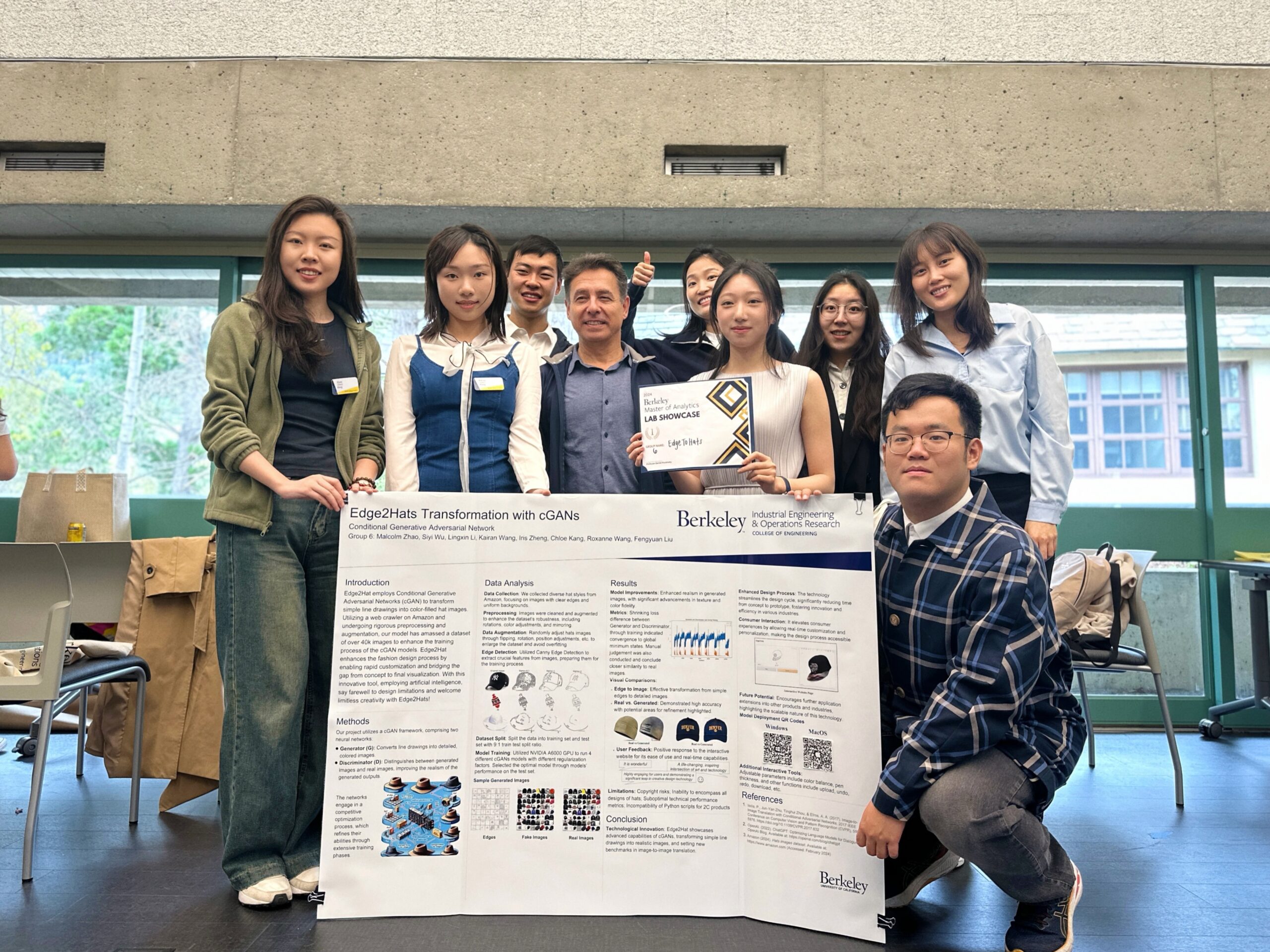
Description: Imagine being able to try on any outfit — without ever stepping into a fitting room. This project builds an end-to-end AI pipeline that lets users upload a photo of themselves and a piece of clothing, then see a strikingly realistic virtual try-on: the right fit, the right texture, the right drape — as if they actually wore it. But it doesn’t stop at one photo. The system generates multi-angle views — front, side, close-up — and even places the outfit into real-life motion scenarios like a commute, a stage performance, or a dance, so shoppers see not just *what* they’d wear, but *how* they’d live in it. Over time, every try-on result gets saved into a personal digital wardrobe, turning a one-off experiment into a growing, reusable fashion asset. For brands, it means transforming static product images into compelling visual content; for users, it means making smarter style decisions — faster, and without the guesswork.
Team: Robert Chang, Shreya Krishnan, Chidubem Nnaji, Ruixin Wang, Junxing Wu, Aarohi Zade
Description: A common trend with traditional music recommendation systems is that they often create generic playlists that don’t align with a listener’s desired mood. To expand past this trend, we created a recommendation system that interprets a user’s emotional intent data and produces an emotionally aligned, context-aware playlist. A user can either describe their current/desired emotional state or input a reference song, which our model passes through a five-step pipeline: heuristics ensembling, song mapping, vector similarity search, ranked lists generation, and Gale-Shapley matching. The result is a playlist that resonates with a user’s current or desired emotional state. Applicable for anyone who listens to music, our system allows music enthusiasts to quickly create highly personalized, emotionally accurate playlists to fit their musical needs.
Team: Yiyang Gu, Cynthia Subroto, Jiaxi Xie, Sammy Heinz, Jerry Shao, Shiwei Chen
Description: Current self-driving cars often react to danger only when it’s nearly too late, which can lead to abrupt braking and uncomfortable rides. To solve this, our team developed an AI system designed to see and predict potential hazards two seconds before they actually happen. Using a massive dataset of real-world driving scenarios, we built a smart model that identifies high-risk situations with extremely high accuracy. We then connected this risk predictor model to a digital driver that learns how to make smoother, safer decisions on the road. This approach allows the car to gently adjust its speed or position ahead of time, rather than slamming on the brakes at the last second. Ultimately, this project shows how artificial intelligence can make autonomous travel feel more natural for passengers while significantly increasing road safety.
Team: An-Chi Lu, Charles Ding, Chengke Wei, Eesha Danish, Yirong Chen, Zixuan Zhao
Description: We developed an intelligent clinical retrieval system built on the MIMIC-IV dataset, leveraging rich patient information across diagnoses, prescriptions, procedures, and other longitudinal medical records. The platform combines embedding-based semantic search with keyword retrieval to identify clinically relevant historical cases from multiple perspectives. Retrieved results are then ranked and reranked using large language models to improve precision, relevance, and contextual understanding. By integrating structured data retrieval with advanced language reasoning, the system delivers more accurate and explainable case matching than traditional search methods. For patients, it can power next-generation support platforms that connect individuals with similar medical histories and surface shared experiences from comparable cases. For physicians, it serves as a decision-support tool by enabling rapid reference to analogous prior cases, treatment pathways, and outcomes.
Team: Jiaqi Li, Jiayi Xu, Junqi Huang, Kelly Zeng, Rameen Faisal, Richie Li Zhang, Rongchuan Shi
Description: This project investigates daily chewing behavior as an underexplored signal for health monitoring by developing an end-to-end pipeline for both health assessment and food-texture classification. Using MediaPipe Face Landmarker, it extracts high-frequency facial landmarks to derive detailed temporal representations of mouth and jaw movements.
To model these temporal dynamics, a bidirectional selective state-space model (Mamba) is employed to classify food textures—soft, medium, and hard—directly from chewing patterns. These predictions are further integrated with behavioral indicators, such as chewing symmetry and rhythm, and interpreted in the context of clinical literature to assess potential metabolic and oral health risks.
The system outputs results through a frontend dashboard that presents structured health reports along with practical recommendations for improving chewing behavior. Overall, the framework provides a scalable and data-driven approach to support pediatric chewing intervention and long-term metabolic health monitoring.
Team: JP Schuchter, Jasmine Guan, Bainuo Bao, Hanning Lin, Lanxi Liu, Yuqian Tao, Caiyuan Yin
Description: Major museums usually display only a fraction of their collections — often less than 10% — leaving the majority in storage, away from the public. GUIA is an app designed to connect visitors to these hidden works through three integrated experiences: visitors describe their interests in natural language and receive a personalized walking route on an interactive floor plan of the museum; they can input the code of any piece that catches their eye to instantly see similar works from the collection, including pieces tucked away in storage; and curators get a dashboard showing which stored works visitors gravitate toward, plus a search tool to browse the reserves by describing ideas for a show. We chose the MET as our initial focus because of its vast collection, the breadth of its open-access metadata, and the availability of images for most pieces — including those in storage. Under the hood, GUIA is powered by a hybrid recommendation model that fuses CLIP visual embeddings — fine-tuned on museum-specific image-text pairs so it learns the language of culture, period, and technique — with machine-learning similarity measures over the MET’s structured metadata, unifying how an artwork looks and how it’s catalogued into a single searchable space. The result: visitors can query hundreds of thousands of artworks using nothing but a natural-language phrase or a mood, and walk away having seen art the museum itself rarely gets to show.
Team: Grusha Shetty, Sanchit Arvind, Ziying Chen, Wen Chia Huang, Roxana Li, Tianyu Zhang
Description: Nothing ends a first date faster than finding out their entire Spotify Wrapped is one artist and zero personality. SpotDating was built so you never have to find out in person. Using over 20,000 users’ listening histories and track-level audio features like danceability, energy, valence, and acousticness, we built a system that understands taste beyond genre labels. We group songs by sound, map each user’s listening history onto those groups, and measure how much two users’ tastes actually overlap. An autoencoder learns each user’s taste profile, and we use heuristic pairings as ground truth to validate how well it captures real compatibility. Platforms like Spotify already have everything needed to make this real, and SpotDating shows exactly how that listening data could finally be put to better use than just a year-end recap.
Team: Information coming soon
Description: Information coming soon
Team: Wish Wang, Zhangrui Ji, Yinghan Sun, Hua Ye, Qijie Yu, Cheng Zeng
Description: Food insecurity is a complex global challenge with the lack of consistent access to enough nutritious food for a healthy lifestyle, especially here in the United States. The project addresses food insecurity by utilizing predictive analytics to provide a cost-optimized, nutritionally balanced grocery basket. Data from the U.S. Bureau of Labor Statistics’ Consumer Price Index are primarily used to estimate and understand the prices consumers pay for selected food items. Using optimization and machine learning concepts, we built a grocery planner that generates a basket that satisfies cost constraints, nutrition targets, and location, based on post-COVID data. We expect this interactive dashboard to translate complex predictive data into a user-friendly grocery planner, where users can find the most cost-effective path to maintain nutritional security.
Team: Mengting Feng, Yuheng Wu, Ryan Lin, Yiran Guo, Yiyue Wang, Oyun Erdene Adilbish, Era Ahsan
Description: The Career Roadmap App is an interactive, AI-powered platform designed to bridge the gap between a candidate’s current profile and their target career goals. By leveraging a custom Machine Learning pipeline, the tool automatically extracts technical competencies from resumes and job descriptions to provide a high-precision skill gap analysis. Our proprietary ranking model goes beyond simple keyword matching, utilizing contextual features and industry relevance to prioritize the most critical skills required by employers. Through an intuitive interface, users can simulate various learning scenarios by adjusting a personalized time budget to see how different commitments impact their marketability. The application then delivers a sequenced, data-driven roadmap with direct course recommendations to help users master their missing skills efficiently. Ultimately, this tool empowers career switchers and students to navigate their professional.
Team: Derrick Chun, Yaolu Shen, Amy Xinyue Ai, Ethan Lam, Nellie Ma, Sean Osborne, Vriddhi Mittal
Description: Our project is a U.S. Semiconductor Supply Chain Digital Twin, a smart and easy-to-use analytics dashboard built for decision-makers who want to protect critical chip imports from global disruptions. We use Simpy-based stochastic simulations and a constrained optimization engine to model how supply flows from major partners like Malaysia and China through domestic ports. The system calculates a Resilience Score that balances transportation costs against concentration risk, using a live optimizer to find the best sourcing mix during a crisis. The tool also simulates real-world “shocks”, such as port labor strikes or geopolitical events, to visualize throughput loss and recovery timelines. Users simply adjust disruption sliders through a Plotly Dash interface, and the system automatically generates recommended reallocations and port shifts to restore stability. In short, this Digital Twin helps stakeholders find better strategies to secure the semiconductor supply chain faster and smarter.